10 Best Aluminum Composite Panel Manufacturers Worldwide

Choosing the right Aluminum Composite Panel Manufacturer requires more than comparing attractive finishes or low quotations. Reliable evaluation considers panel structure, coating durability, fire performance, production capacity, and technical support. These factors affect façades, signage, interior walls, and long-term maintenance costs.

This guide examines ten respected manufacturers serving international markets. Their capabilities may differ across regions and applications. Some focus on architectural façades, while others specialize in advertising panels, industrial cladding, or customized surfaces. Important details include aluminum skin thickness, core composition, coating technology, color consistency, and quality-control procedures. Certifications and independent test reports also deserve close attention.

Real project experience provides another useful perspective. A manufacturer may offer impressive samples, yet installation problems can reveal weaknesses later. Packaging, delivery protection, fabrication guidance, and responsive after-sales service matter on active construction sites. Small details count. A scratched panel can delay an entire façade section.

The ranking should not be treated as absolute. Market conditions, local standards, project scale, and installer expertise can change the best choice. Some information may also require direct verification with suppliers. That is worth acknowledging. Buyers should request current technical data, warranty terms, test documentation, and references from comparable projects before signing contracts. This practical approach supports informed decisions and reduces avoidable risks when selecting an international aluminum composite panel partner.
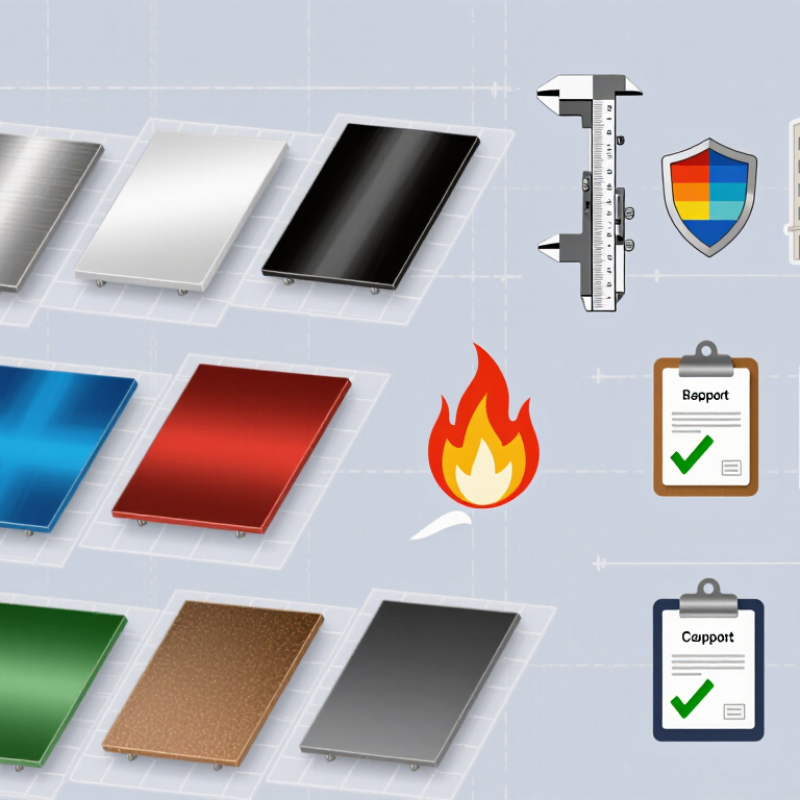
10 Best Aluminum Composite Panel Manufacturers Worldwide

Global Aluminum Composite Panel Manufacturing Landscape

The global aluminum composite panel manufacturing landscape is becoming more regional, automated, and specification-driven. Fortune Business Insights valued the market at about USD 6.34 billion in 2023 and projected it to reach USD 10.04 billion by 2032. However, reported figures vary because analysts classify panels, cores, and applications differently.

Manufacturers now compete through coating durability, core performance, recycling systems, and delivery reliability. Asia-Pacific remains a major production and consumption center, supported by urban construction and transport projects. Europe emphasizes fire performance, environmental declarations, and circular design. North America shows steady demand for façades, signage, and commercial renovation. These patterns are useful, but they do not identify the best supplier alone. Factory audits still matter. A polished brochure proves little.

Tips: Compare coating warranties with independent test results. Check core composition, batch traceability, and production capacity. Ask for samples exposed to heat, moisture, and ultraviolet light. The right manufacturer should explain limitations clearly, not only advertise strength. Also review regional fire codes before approving a panel system. MarketsandMarkets has projected continued growth for aluminum composite panels through the decade, yet installation quality can weaken real-world performance. That uncomfortable detail deserves more attention.

Key Criteria for Evaluating Leading ACP Manufacturers

10 Best Aluminum Composite Panel Manufacturers Worldwide

Leading ACP manufacturers deserve evaluation beyond catalog images and low quotations. Start with core quality: aluminum alloy grade, skin thickness, coating system, adhesive consistency, and flatness after thermal cycling. Request batch-level test records, not only a general brochure. EN 13501-1 fire classification, ASTM E84 results, and ISO 9001 certification can improve confidence, but certificates must match the exact panel construction. A fire test on one core type proves little for another.

Durability also needs measurable evidence. Ask for accelerated weathering data, coating gloss retention, color change, peel strength, and impact resistance. The American Architectural Manufacturers Association’s testing framework shows why exposure, adhesion, and water resistance should be assessed together. Sustainability deserves equal attention. The International Aluminium Institute reports that recycled aluminium requires roughly 5% of the energy used for primary aluminium. However, recycled content alone does not prove a lower overall footprint. Review an Environmental Product Declaration, transport distance, coating chemistry, and end-of-life recovery options. I would not trust a glossy sample without traceable records.

Tips: Compare three technical data sheets side by side. Check the same thickness, core, and test method. Visit production lines when possible. Inspect coil storage, lamination temperature control, and sample retention. Small gaps often reveal large process weaknesses. A cheaper panel may perform well, but the evidence must carry that claim.

10 Best Aluminum Composite Panel Manufacturers Worldwide — Key Criteria for Evaluating Leading ACP Manufacturers

Procurement weighting model for comparing ACP manufacturers. The percentages represent the relative importance of common technical, quality, sustainability, and delivery criteria; they are not market-share data.

Fire performance and weather durability receive the highest weighting because they directly affect building safety, service life, and regulatory compliance. Bond strength, panel flatness, certification, sustainability, and lead time provide additional evidence of manufacturing reliability and project suitability.

Profiles of Ten Notable Aluminum Composite Panel Manufacturers

A German manufacturer is known for tight coating control and precise panel flatness. Its production team checks color variation under standard lighting. A Japanese producer focuses on fire-resistant cores and disciplined process records. Samples are tested before large orders leave the plant. An Italian fabricator offers refined finishes for retail façades and interior wall systems. Its technical staff often assists with curved cutting details. A South Korean manufacturer combines automated lamination with fast custom sizing. However, buyers should verify long-term weathering data, not trust appearance alone.

A Turkish producer serves large construction projects with broad coil-processing capacity. Its strength is consistent output during demanding schedules. A Chinese manufacturer provides extensive surface patterns and competitive production volumes. Factory visits remain useful because catalog images can hide small coating defects. An Indian producer develops panels for hot climates and emphasizes thermal movement control. Installation guidance is important, since poor joint spacing may damage otherwise reliable panels. A Middle Eastern manufacturer adapts finishes for intense sunlight and dusty conditions. Its testing documentation deserves careful review.

A North American producer emphasizes specification support, project traceability, and installer training. That practical involvement can prevent costly site mistakes. A Southeast Asian manufacturer supplies lightweight panels for commercial renovations. Its flexible order quantities suit smaller contractors, although delivery consistency should be checked. Across these ten profiles, serious manufacturers show measurable quality systems, clear technical data, and responsive after-sales support. No factory is flawless. Independent testing and sample approval still matter.

Core Products, Technologies, and Industry Applications

The best aluminum composite panel manufacturers are judged by products, process control, and application results. Core options include polyethylene, fire-retardant mineral, and honeycomb structures. Mineral cores suit high-rise façades, while polyethylene cores often fit signage and low-risk interiors. Coil coating with PVDF or FEVE improves color stability, weather resistance, and surface consistency. CNC routing, calibrated bending, and protective films reduce installation damage.

UNEP’s 2024 Global Status Report says buildings and construction consume 32% of global energy and create 34% of global carbon emissions. This increases demand for lightweight façade systems that support insulation and reduce structural loads. The International Aluminium Institute reports that recycled aluminum uses about 95% less energy than primary aluminum. Therefore, manufacturers with closed-loop scrap recovery deserve closer attention. Still, ranking suppliers is not perfectly objective. Testing quality can vary between regions and projects.

Tips: Check fire-test reports, coating warranties, and batch traceability. Ask for samples. Inspect the core, not only the color. Review wind-load data for the exact installation zone. A lower price may hide thinner skins, weaker bonding, or limited technical support. Manufacturers serving transport interiors, retail façades, cleanrooms, and modular buildings should show application-specific evidence. That evidence matters more than polished brochures.

10 Best Aluminum Composite Panel Manufacturers Worldwide - Core Products, Technologies, and Industry Applications
Industry Profile Core Product Configuration Typical Panel Construction Key Manufacturing Technologies Performance Characteristics Primary Industry Applications Common Standards and Test Areas
Profile 01 Standard polyethylene-core aluminum composite panel Two aluminum skins bonded to a low-density polyethylene core; commonly produced in standard architectural panel thicknesses.
  • Continuous coil coating
  • Thermal lamination
  • Precision slitting and panel cutting
Low weight, good flatness, easy routing and folding, and efficient material utilization. Exterior signage, shopfronts, fascia, canopies, interior wall features, and general decoration. Surface coating durability, dimensional stability, adhesion, color retention, and bending performance.
Profile 02 Fire-retardant mineral-filled composite panel Aluminum skins combined with a mineral-filled polymer core designed to reduce flame spread and heat release.
  • Mineral-core compounding
  • Continuous extrusion or lamination
  • In-line thickness and surface inspection
Improved fire performance compared with conventional combustible polymer-core panels while retaining lightweight construction. Commercial façades, transport facilities, public buildings, retail centers, and high-occupancy interiors. Reaction-to-fire classification, smoke production, flame spread, heat release, and façade system testing.
Profile 03 Non-combustible or limited-combustibility mineral-core panel Aluminum skins bonded to a predominantly inorganic core, with the exact fire classification dependent on the complete tested system.
  • High-mineral-content core processing
  • Controlled bonding and press lamination
  • Automated flatness measurement
High fire-resistance potential, stable panel geometry, and suitability for projects with stringent building-code requirements. High-rise façades, hospitals, schools, airports, transportation hubs, and public infrastructure. EN 13501-1, ASTM E84, NFPA 285, ASTM E136, or equivalent local fire-performance requirements, as applicable.
Profile 04 PVDF-coated architectural façade panel Aluminum composite panel with a factory-applied fluoropolymer finish, often selected for long-term exterior exposure.
  • Chromate-free or conversion pretreatment
  • Multi-layer coil coating
  • Controlled curing and gloss measurement
Strong resistance to ultraviolet exposure, weathering, chalking, and color fading when properly specified. Building façades, curtain-wall infill, column covers, roofline details, and long-life exterior cladding. Coating adhesion, pencil hardness, gloss retention, accelerated weathering, color difference, and corrosion resistance.
Profile 05 Interior-grade polyester-coated composite panel Aluminum skins with a polyester paint finish intended primarily for protected interior or short-term exterior environments.
  • Roll coating
  • Digital color matching
  • CNC cutting, routing, and grooving
Cost-efficient appearance, consistent color, easy fabrication, and a broad range of decorative finishes. Retail interiors, partitions, ceilings, elevator surrounds, exhibition displays, and wall decoration. Coating adhesion, abrasion resistance, stain resistance, chemical resistance, and indoor air-quality requirements.
Profile 06 High-gloss, matte, brushed, or wood-effect decorative panel Composite panel with a decorative surface treatment, printed pattern, embossed texture, or metallic appearance.
  • Wood-grain or stone-effect printing
  • Embossing and texturing
  • Protective clear-coat application
Consistent visual appearance, design flexibility, low maintenance, and lighter weight than many solid decorative materials. Hospitality interiors, residential towers, retail fit-outs, furniture components, feature walls, and branded environments. Surface uniformity, scratch resistance, stain resistance, UV stability, cleanability, and color consistency.
Profile 07 Signage and digitally printable aluminum composite panel Flat aluminum composite sheet engineered for screen printing, digital printing, vinyl application, or direct graphic finishing.
  • Fine surface preparation
  • Ink-receptive coating systems
  • High-speed cutting and routing
Good print definition, smooth surface, low moisture absorption, and efficient production of rigid signs. Traffic signs, retail signage, information boards, advertising displays, exhibition graphics, and wayfinding systems. Ink adhesion, surface energy, weathering, flatness, edge quality, and resistance to cleaning chemicals.
Profile 08 Perforated or routed acoustic composite panel Aluminum composite sheet with engineered perforations, slots, or routed patterns, sometimes combined with an acoustic backing layer.
  • CNC perforation and routing
  • Pattern registration
  • Deburring and edge finishing
Decorative screening, controlled light transmission, ventilation potential, and improved acoustic performance when used with an absorber. Ceilings, interior partitions, transport interiors, building screens, balconies, and acoustic feature walls. Perforation accuracy, structural integrity, acoustic absorption testing, corrosion resistance, and fire performance of the full assembly.
Profile 09 Lightweight honeycomb aluminum composite panel Thin aluminum face sheets bonded to an aluminum honeycomb core for increased stiffness-to-weight performance.
  • Honeycomb cell expansion
  • Film or adhesive bonding
  • Large-format flat-panel pressing
High bending stiffness, low mass, reduced deflection, and suitability for large-format panels. Transportation interiors, aircraft and marine fit-outs, elevator systems, cleanrooms, ceilings, and high-end architectural interiors. Core shear strength, peel strength, bending stiffness, impact resistance, fire performance, and panel flatness.
Profile 10 Recyclable aluminum-based composite panel for circular construction Panel system designed to facilitate separation and recovery of aluminum skins and core materials at end of service life.
  • Material-efficient coil processing
  • Low-waste cutting optimization
  • Mechanical or separable bonding approaches
Reduced material waste, potential for aluminum recovery, long service life, and compatibility with sustainability-focused specifications. Green building façades, commercial interiors, modular construction, renovation projects, and design-for-disassembly applications. Recycled content verification, life-cycle assessment, environmental product declarations, VOC emissions, durability, and end-of-life recyclability.
Note: Fire classifications, coating durability, structural performance, and recyclability depend on the specific panel composition, manufacturing process, installation method, and applicable local codes. Project specifications should be verified through current technical documentation and accredited testing.

Quality Standards, Sustainability, and Market Presence

10 Best Aluminum Composite Panel Manufacturers Worldwide

The strongest manufacturers distinguish themselves through repeatable quality, not attractive brochures. In practical inspections, panel flatness, coating thickness, peel strength, and color consistency deserve close attention. Reliable producers publish test reports from accredited laboratories and maintain traceability for each production batch. Quality systems such as ISO 9001 can support confidence, but certification alone never proves excellent performance. Fire classification, weather resistance, and dimensional stability should match the project’s location and building requirements.

Sustainability now shapes the global market presence of leading manufacturers. Better suppliers disclose recycled aluminum content, responsible sourcing practices, and product life-cycle data. Environmental Product Declarations can make comparisons more transparent. Some facilities reduce process waste, energy use, and packaging materials. However, sustainability claims are not always complete. Recycling rates may vary by region, while long-distance shipping can weaken environmental benefits. This deserves careful review. Market strength also depends on technical support, regional stock, installer training, and dependable after-sales service. A large distribution network is useful, but local responsiveness often matters more.

Tips: Request recent batch records, independent fire tests, and coating warranties before approval. Compare core composition, not only price. Visit a production site when possible. Ask how defective panels are handled. Small details reveal reliability. A sample may look perfect, yet installation feedback can expose weaknesses in cutting, routing, or protective-film removal.

This website uses cookies to ensure you get the best experience. By continuing to browse on this website, you accept the use of cookies for the above purposes.