560 Glasgow St, London, ON N5W 4A3

Choosing sliding door hardware is not just a matter of picking a handle that looks good. The track, rollers, guides, and stops all affect how smoothly a door moves and how well it stays aligned. A heavy barn-style panel, for example, needs different support from a lightweight closet door. Small details matter.
This guide introduces ten common types of sliding door hardware and explains where each may fit. You’ll encounter top-mounted tracks, bypass systems, pocket-door frames, soft-close mechanisms, floor guides, and other practical options. Each has trade-offs. Some systems save floor space, while others expose the track as a visible design feature. Not every option suits every opening.
Before buying, measure the door’s width and thickness, check its weight, and note the available wall and floor clearance. A track that looks suitable online may not match the door or mounting surface in your home. Verify load ratings, included components, and installation requirements with the manufacturer’s specifications. For a frequently used door, roller quality and smooth movement deserve close attention. For a bathroom or laundry area, finish durability may matter more than appearance alone.
There is no perfect setup for every room. I’d be cautious about choosing by price or photos only; I’ve seen how one overlooked measurement can turn a simple upgrade into a frustrating fit. The sections ahead offer a practical starting point for comparing sliding door hardware before you order.
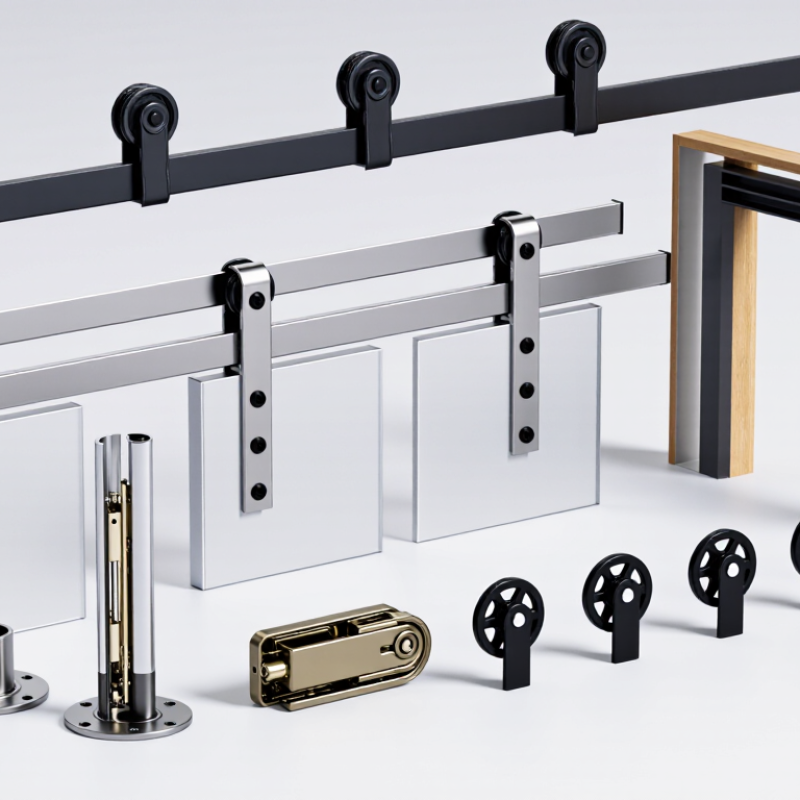
ANSI/BHMA A156.14 sets performance requirements and test methods for sliding and folding door hardware. For buyers comparing rollers, tracks, guides, pivots, and related components, this standard helps define what is being assessed. It is a useful scope check, not a promise that every part of a door opening has been evaluated.
A sliding door may glide smoothly in a showroom yet bind after repeated use. A156.14 testing can provide relevant performance information, but buyers should confirm which hardware category and standard edition apply to the product. Ask for test documentation, rated door weight, and compatible track dimensions. Small mismatches matter. A roller that fits the track poorly can cause noise, uneven movement, or premature wear.
The standard addresses hardware, not every condition at the job site. It should not be treated as proof that a complete door, frame, wall attachment, or installation meets all project needs. Check clearances, expected traffic, and the door’s actual weight before selecting components. I would also leave room for installation quality: even well-tested hardware can disappoint when the track is out of level. That detail is easy to overlook.
ANSI/BHMA A156.14 is the industry standard for covered sliding and folding door hardware. Confirm the applicable edition, hardware category, and product documentation when comparing options; not every accessory is necessarily evaluated under this standard.
| # | Hardware Type | Primary Function | Common Configuration | Buyer Checks | A156.14 Scope Note |
|---|---|---|---|---|---|
| 1 | Track or Rail | Provides the running path for sliding door hangers or rollers. | Top-mounted track for suspended doors; track length and profile vary by system. | Confirm door weight and width limits, mounting surface, track length, and whether the track can be cut to size. | A core component of sliding door hardware; check that the specified system is documented for the applicable standard and duty. |
| 2 | Hangers and Roller Assemblies | Support the door and allow it to travel along the track. | Paired hanger assemblies with wheels or rollers attached to the top of the door. | Check the stated capacity per door and per hanger, wheel material, adjustment range, and compatibility with the track. | Hangers are part of sliding-door hardware; evaluate them as part of the compatible assembly where required. |
| 3 | Bottom Guide or Guide Channel | Controls sideways movement and helps keep the door aligned during travel. | Small floor-mounted guide, door-mounted guide, or a channel concealed in the door bottom. | Verify door thickness, floor clearance, guide position, and whether the guide is suitable for the finished floor. | Guiding components may be included in a covered sliding-door system; confirm the product’s stated scope. |
| 4 | Floor Guide | Steers the lower edge of a sliding door without supporting its weight. | Fin-mounted, roller-style, or adjustable guide fixed to the floor or wall. | Check installation location, floor conditions, door-edge clearance, and the risk of creating a trip or cleaning obstruction. | Often used with sliding-door hardware; verify whether the guide is included in the standard evaluation or specified separately. |
| 5 | Folding-Door Pivot and Hinge Hardware | Supports and guides folding leaves as they pivot and stack. | Top and bottom pivots, intermediate hinges, and related carriers selected for the folding-door layout. | Confirm the number and width of leaves, door mass, pivot locations, handing, and the required opening direction. | Folding-door hardware is within the standard’s stated subject area; check the tested configuration and product documentation. |
| 6 | Flush Pulls | Provide a recessed grip while keeping the door surface relatively unobstructed. | Recessed cup or finger-pull hardware fitted into the door stile or face. | Check door thickness, cutout dimensions, edge distance, grip access, and compatibility with any lock. | A pull may be an accessory to the door system. Confirm whether its performance is covered by the cited standard or another specification. |
| 7 | Surface-Mounted Pulls | Provide a graspable handle for opening and closing the door. | Bar, loop, or plate pull fastened to the door face. | Review projection, fastener type, mounting reinforcement, clearance from adjacent doors, and accessibility needs. | Check the applicable product standard and project requirements; do not assume every pull is evaluated under A156.14. |
| 8 | Sliding-Door Lock or Privacy Set | Secures a sliding door or provides privacy where the application requires it. | Hook-bolt, privacy, or keyed locking mechanism paired with a compatible strike or receiver. | Confirm door preparation, backset or placement, handing, emergency-release needs, and compatibility with the pull and frame. | Locking functions may be governed by additional requirements or standards. Check the lock’s own documentation and project specification. |
| 9 | Track Brackets and Splice Connectors | Attach track to its support and join track sections where a longer run is needed. | Wall or ceiling brackets, blocking-supported mounts, and alignment connectors for track joints. | Check substrate, fastener type, bracket spacing, load path, and whether a joint is permitted in the travel area. | Mounting parts affect system installation and performance; verify that the specified assembly follows the hardware instructions. |
| 10 | Stops and Soft-Close Accessories | Limit travel, cushion end movement, or help slow and close a door near the end of its travel. | Track-mounted end stops, door stops, or add-on dampers designed for a compatible system. | Check compatibility, adjustment range, door mass limits, available track space, and whether the accessory is included in system testing. | These accessories may be evaluated as part of a specific system or separately; confirm the scope of the product documentation. |