Top 10 Types of Double Barn Door Hardware
Choosing the right double barn door hardware involves more than matching black steel to a farmhouse interior. The system must carry the door’s weight, control movement, and protect nearby walls. A quiet roller is useful in a bedroom. A heavy-duty track is safer for wide solid-wood doors. Small details matter, too. Track length, door thickness, floor clearance, and wall strength can change the entire installation.
Door hardware consultant Mark McCoy says, “A barn door should glide with control, not simply look impressive.” That principle guides this overview of the top 10 types of double barn door hardware. Each type serves a different purpose, from bypass systems that save hallway space to synchronized rollers that keep two panels moving evenly. Some designs suit modern glass doors. Others work better with reclaimed timber and visible fasteners.
The practical differences are easy to miss. A compact hanger may look elegant but struggle under daily use. A soft-close mechanism may reduce noise, yet it cannot correct a weak mounting surface. Installation experience also teaches an uncomfortable lesson: attractive hardware is not always durable hardware. Measurements can be slightly wrong. Walls can be less solid than expected. This guide considers those real-world imperfections while comparing strength, movement, maintenance, appearance, and installation demands. The goal is not to promote one finish or brand. It is to help readers select double barn door hardware that feels stable, operates smoothly, and remains dependable after the newness fades.
Double Barn Door Hardware: Definition and Core Components
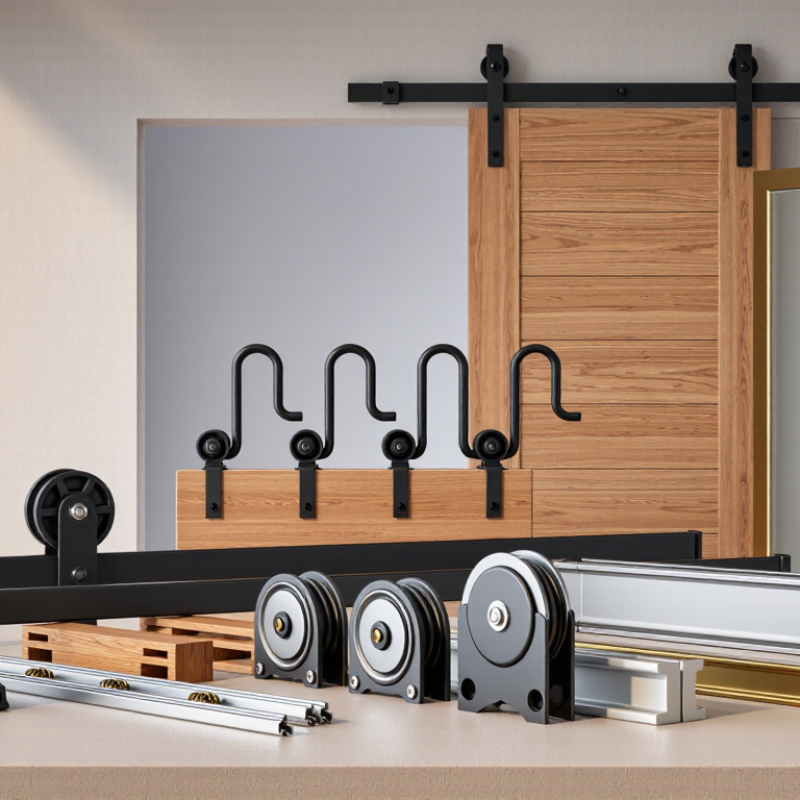
Double barn door hardware is the system that lets two door panels slide horizontally across one opening. Unlike a single-door setup, it must coordinate two moving panels without creating uneven gaps. The hardware usually includes a steel track, two roller assemblies, door hangers, floor guides, end stops, and mounting brackets. Some systems also include anti-jump devices or soft-close mechanisms.
The track carries the main load, so its length and mounting surface require careful checking. Each roller attaches to a hanger fixed near the top of a door panel. The floor guide keeps the panel from swinging, especially when someone opens it quickly. End stops control the travel distance and protect the rollers from hard impacts. For overlapping panels, spacers may be necessary to keep the doors aligned and prevent rubbing.
In practical installation work, accurate measurements matter more than attractive hardware. I check the wall structure, door thickness, panel weight, and clearance above the opening. A small error can make both doors scrape or stop unevenly. I still recheck the centerline before drilling; guessing here is a poor habit. The ten common types vary by mounting method, movement pattern, and door arrangement, but their core components remain similar. Smooth operation depends on correct spacing, secure fasteners, and a level track. Even high-quality parts cannot correct a weak wall or careless alignment.
Top 10 Types of Double Barn Door Hardware
Double Barn Door Hardware: Definition and Core Components
Double barn door hardware is the sliding mechanism used to support and guide two door panels.
A typical system includes a track, rollers, mounting brackets, door stops, anti-jump devices,
floor guides, and handles. The chart compares representative core-component counts for common
double-door configurations; accessory quantities vary by door size and installation method.
Soft-close and folding systems generally require additional functional parts, while standard,
aluminum, stainless-steel, and ceiling-mounted systems typically use a simpler component set.
Bypass and bi-parting designs need extra guides or synchronized movement hardware to keep both
panels aligned.
How Double Barn Door Hardware Systems Work
Top 10 Types of Double Barn Door Hardware
Double barn door hardware systems use two door panels that slide horizontally from a shared opening. Each panel hangs from rollers attached to a steel rail. When the doors meet, a floor guide limits swinging and keeps the panels aligned. Common configurations include bypass, bi-parting, wall-mount, ceiling-mount, top-mount, bottom-roller, exposed-rail, concealed-rail, soft-close, and telescopic systems.
The operating principle is simple, but installation tolerance matters. The rail must support the combined door weight, not just one panel. Installers usually check the header, stud spacing, roller clearance, and floor level before drilling. A 72-inch opening needs carefully balanced travel, especially when both panels move together.
Soft-close devices reduce impact near the end of travel. They also add adjustment points. That can become a maintenance issue.
The U.S. Department of Energy’s Energy Saver guidance estimates that windows account for about 25% to 30% of residential heating and cooling energy use. Barn doors are not airtight, so their side and center gaps should not be treated as insulation. Freedonia’s 2024 door and window hardware analysis identifies renovation and replacement work as important demand drivers. That supports practical hardware upgrades, but it does not prove every sliding system saves energy. In real projects, a quiet roller can matter more than a decorative finish. I would also recheck the load rating after installation. Manufacturers’ ratings assume correct mounting, and real walls are rarely perfect.
Ten Major Types of Double Barn Door Hardware
Double barn door hardware comes in ten major types, each suited to a different opening and design goal. Standard flat-track hardware offers simple installation and visible industrial character. Top-mount systems keep the rollers above the door, reducing floor contact. Bypass hardware lets one door slide behind the other in narrow spaces. Bi-parting hardware moves both doors away from the center. Soft-close systems slow the final movement and reduce impact noise.
Strap hardware uses broad, decorative hangers that suit farmhouse interiors. Box-track hardware hides the rollers inside a protective metal channel. Stainless steel hardware handles humid rooms more reliably than ordinary untreated steel. Concealed hardware creates a cleaner wall appearance, although installation requires accurate measurements. Ceiling-mounted systems work when wall framing cannot support a conventional rail. Small details matter.
During installation, I check door weight, track length, wall structure, and floor clearance before drilling. The track usually needs to extend beyond the opening on both sides. Double doors also require equal panel widths and careful alignment. A six-millimeter height difference can make the meeting edges look uneven. Soft-close parts need adjustment after the doors settle. This step is easy to overlook. Not every attractive kit performs well on a heavy timber door. I once underestimated handle clearance and had to reposition the pull. That mistake reinforced a practical rule: measure the closed doors, the moving path, and the surrounding trim together. Safety stops and anti-jump guides should remain firmly secured during regular use.
Installation, Maintenance, and Safety Considerations
Installing double barn door hardware starts with the wall, not the doors. Check the header for solid framing, or add a securely fastened backing board. Measure twice. Mark the track with a level. A small slope can make two doors drift apart. Choose hardware rated above the doors’ combined weight. Leave clearance for trim, handles, and the floor guide. Secure the anti-jump blocks firmly. Test each door slowly by hand.
Use fasteners suited to wood, masonry, or metal framing. Do not rely on decorative screws alone. For wide openings, keep the track straight across its full length. Install the floor guide where it limits swinging without scraping the door bottom. Keep fingers away from the meeting seam and roller path. A second person should support heavy panels during lifting.
Maintenance is simple but regular. Inspect bolts, spacers, rollers, stops, and guides every few months. Tighten loose hardware, remove dust from the track, and replace cracked components promptly. Use lubricant suitable for the hardware material; excess oil attracts grit. Watch for wobbling, unusual noise, uneven gaps, or rebounding doors. Stop using the system if the track bends or a roller leaves its channel. I once found a stable-looking door with a shifting bolt. That mistake was preventable. My checklist is not perfect, so I photograph each connection before covering it.